

.webp)
.webp)
A barn renovation is one of the biggest investments a farm makes. New cladding, improved ventilation, upgraded equipment, better insulation. There is a lot going on and a lot of money moving at once.
It is also the single best opportunity you will have to get your lighting right.
Not because lighting is the most expensive part of a renovation. It is usually far from it. But because once the walls are up, the cabling is done, and the flock or herd is back in, changing your mind about the lighting becomes a much bigger job. The decisions you make before you break ground stay with you for the next ten to fifteen years.
Why renovation is the right moment
Outside of a planned renovation, most lighting upgrades happen reactively: a lamp fails, production drops, or a new regulation requires a change. Those moments come with constraints. You are working around a live flock, existing cable runs, and budget that was not planned for the project.
A renovation removes those constraints. You have access to the full structure. Cable routing can be planned from scratch. Mounting positions can be chosen for optimal distribution rather than retrofitted around what was already there. And the cost of integrating new lighting into the project is significantly lower than a standalone installation later. Simply put:
If you are already spending on the structure, the marginal cost of doing the lighting properly is small. The cost of doing it poorly and having to revisit it in three years is not.
What to think about before you specify
1. Start with your animal type and housing system:
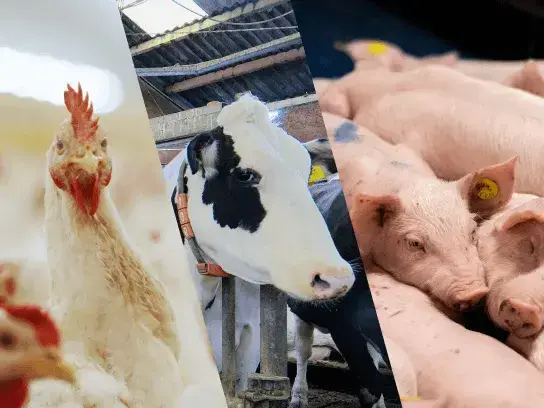
Lighting requirements vary significantly between a broiler house, a layer barn with nesting rows, a free-range system, and a dairy facility. The intensity levels, uniformity requirements, mounting heights, and photoperiod programmes all differ. Your lighting specification should follow your production system, not be picked off a standard list. This is exactly how we approach it at HATO. Before we recommend anything, we want to understand what you are housing, how the barn is laid out, and what your production goals are. A broiler house and a dairy barn are completely different environments, and they deserve completely different lighting solutions.
2. Think about uniformity before you think about brightness:
A common mistake is specifying lux levels without paying attention to uniformity. A barn with an average of 20 lux but significant variation between bright and dark zones will underperform compared to a barn with consistent, even distribution at the same average. Animals respond to their local light environment, not the average. HATO systems are designed with uniform light distribution as a core engineering principle, not an afterthought. Our photometric calculations model the actual distribution in your specific barn dimensions before a single fixture is installed.

3. Plan your control system at the same time:
A lighting upgrade without a proper dimming and programme controller limits what you can do with it. Gradual dawn and dusk simulation, breed-specific photoperiod programmes, and seasonal adjustments all require a control system planned in from the start. Adding it after the fact is always more expensive. HATO's control systems are built to integrate with the lighting from day one. From simple dimming to fully programmable photoperiod management, we make sure you have the control you need to run your animals the way your production system demands.
4. Account for the environment your lights will work in.
Barns are demanding. Dust, ammonia, moisture, and temperature swings shorten the life of lights that are not built for the conditions. The IP rating and build quality of your chosen fixture matters as much as the photometric performance. A light that delivers the right lux on day one but degrades significantly within two years has not done its job. HATO fixtures are built specifically for agricultural environments. Our products carry high IP ratings, are ammonia-resistant, and are engineered to maintain their performance over the long term. That is why we back them with an 8-year warranty, and why so many farmers report years of trouble-free operation.
5. Check your cabling and circuit capacity.
LED systems draw far less power than the fluorescent or incandescent fixtures they replace, which means existing cable runs are often oversized for the new load. This is worth reviewing with your electrician before the project starts, as it can affect how circuits are grouped and where dimmers are installed. Our team can help you think through this at the planning stage, so there are no surprises when the installation begins.

The questions worth asking any lighting supplier
Not every supplier will be the right fit for your renovation project. Before you commit, it is worth asking a few direct questions.
 Can they provide photometric calculations for your specific barn dimensions and housing system?
A supplier who offers a standard product list without modelling the light distribution in your actual space is not giving you enough to make an informed decision. At HATO, planning is part of how we work, not an optional extra.
What is the warranty, and what does it cover?
Understand whether the warranty covers lumen maintenance, not just component failure. A light that dims to 60 percent of its original output within four years has effectively failed, even if the hardware is technically still working. HATO's 8-year warranty covers real-world performance, not just parts.
Do they have experience with your animal type?
The science of poultry lighting and dairy cattle lighting is different in meaningful ways. With over 50 years of experience across broilers, layers, parent stock, dairy cattle, veal calves, and more, HATO has the depth to give you advice that is specific to your animals, not generic to barns in general.
One last thing
The best time to involve your lighting supplier is before the architect draws the cable routing. Not after. A good supplier will want to understand your building plans, your housing system, and your production goals before recommending anything.
At HATO, that is exactly how we work. We get involved early, ask the right questions, and make sure the lighting is designed for your building and your animals from the ground up.
Planning a renovation? Let us be part of the conversation before you break ground.

Care to share?


